Architecture as Geo-Therapy:
Crafting healing spaces with organic materials that form a bioactive matrix, nurturing both body and planet.
We have carefully researched and developed construction techniques using locally available, natural, raw and organic materials.
With almost zero processing required, these widely available materials allow us to create alkaline, breathable and health-enhancing living spaces, which actively purify indoor air, regulate humidity and reduce electromagnetic stress.
The prehistoric origins of limestone and its role in the Great Oxygenation Event
Formation and composition of limestone sediments
Limestone, composed of calcium carbonate (CaCO₃), started to form over the Archean Eon. For more than 4 billions of years, organisms such as corals and mollusks, extracted calcium from the oceans and carbonate ions from the volcanic earth atmosphere to construct their shells and skeletal structures.
Over geologic timescales, these biological deposits accumulated on ocean floors, forming extensive carbonate sediments.
How limestone geological formation participated in the “Atmospheric oxygenation”
Marine organisms played a critical role in Earth’s carbon cycle by sequestering atmospheric CO₂ through the biomineralization of their shell. Billions years of accumulation of their calcium carbonate structures effectively reduced atmospheric carbon dioxide levels, contributing to the stabilization of Earth’s climate and oxygenation of the atmosphere. This process enabled the transition of life from marine to terrestrial environments.
Geological Lithification
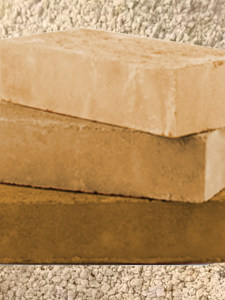
Under high ocean pressures, these layers of organic carbonate material underwent lithification, compaction and cementation. These diagenetic processes transformed these sediments into dense, coherent limestone.
Ramming limestone, an engineered process bio-mimicking geological lithification
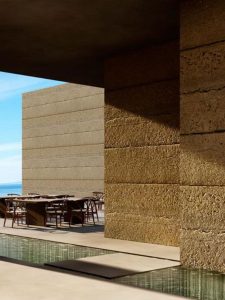
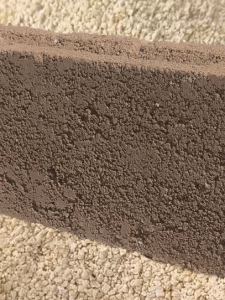
We build rammed earth walls using limestone and lime, an engineered concretion process that is a direct biomimicry of the natural processes this materials underwent under antic oceans pressures.
Indeed, a concretion or “stalactite effect” is then taking place: limestone (CaCO3) and lime (CaO) are reacting to the carbon dioxide (CO2) present in the atmosphere, forming a compact mass of matter within the spaces between particles of limestone aggregates.
Once upon a time, Earth was a fiery orb.
Its surface, a chaotic canvas, painted with volcanic explosions and rivers of glowing lava. From the tempestuous ash and swirling gas clouds, the immutable laws of physics wove their magic, coaxing the first rains to fall and the first oceans to rise.
Primordial waters where life would whisper its first breath.
In those ancient seas, the first cells stirred.
Tiny miracles of chemistry, they danced in the warm, mineral-rich tides, gathering energy and purpose. A magestral purpose.
Over billions of generations, some of these humble living beings learned to wave the calcium of the seas and the carbon of the volcanoes into the very first shells and corals.
Over eons, a vast family of calcium-weaving lifeforms devoted their existence to a sacred task: drawing carbon dioxide from Earth’s thick, primordial skies.
Atom per atom
Off the volcanic clouds
Shell by shell
In Calcium forged
Inch by inch
Of Coral grown
Weaving breath into the air
They softened our atmosphere
Then off the seas they crawled
Then upon virgin shores we bloomed
Millions of years later, their legacy became our inheritance.
Across the globe, mountains of these ancient architects rose
Layer upon layer of their remains
Pressed by the weight of ages
Bathed in Earth’s mineral-rich seas,
Petrified into limestone.
A cathedral of stone
A geological hymn to life’s ingenuity.
Clay: nature’s air-purifying, humidity-balancing natural building material formed over millennia
Formation and composition of clay sediments
Clay, a fine-grained sedimentary material, originates from the geological weathering of rocks rich in aluminosilicate minerals, like feldspar in granite, over millions of years. Physical processes, such as erosion by wind and water, and chemical weathering, like hydrolysis, break these rocks into tiny particles less than 2 micrometers in size. Deposited in low-energy environments like riverbeds, lakes, or ocean floors, these particles compact under pressure, often mixed with water, organic matter, or minerals like quartz. Over time, diagenesis—compaction and mineral alteration—transforms these deposits into clay-rich sediments. This versatile material, abundant in Earth’s crust, is key to natural construction due to its plasticity and binding properties.
Clay’s colloidal structure—composed of ultra-fine, charged mineral particles suspended in a matrix—plays a critical role in its air-purifying properties when used in earthen construction. Here’s how it works:
Air purifying abilities
Clay particles carry a natural negative charge due to their mineral composition (e.g., silica, alumina). This charge attracts and binds positively charged airborne pollutants, such as:
– Allergens (pollen, dust mites)
– Pathogens (bacteria, mold spores)
– Volatile Organic Compounds (VOCs) from paints, plastics, or cleaning products
– Heavy metals (e.g., lead, formaldehyde) bind to clay’s exchange sites, neutralizing their toxicity.
– Negative ions are released, which counteract positively charged airborne particulates (dust, smoke), causing them to fall out of the air.
Humidity Regulation
The colloidal structure creates a porous, hygroscopic (moisture-absorbing) material. Clay walls or plasters:
– Absorb excess moisture from humid air, reducing mold growth.
– Release stored moisture in dry conditions, maintaining balanced indoor humidity (40–60% ideal).
This dynamic stabilizes the indoor environment, preventing the airborne spread of damp-related toxins and allergens.
Surface Area & Catalytic Activity
The microscopic scale of colloidal clay particles creates an enormous surface area relative to volume. This allows:
– Enhanced adsorption of pollutants.
– Natural catalytic breakdown of organic pollutants (e.g., VOCs) via redox reactions with clay’s trace minerals (iron, manganese oxides).
Far-Infrared Radiation (FIR)
Clay’s colloidal minerals emit subtle far-infrared rays, a phenomenon linked to:
– Neutralizing microbial activity (inhibiting mold/bacteria).
– Breaking down water clusters in humid air, improving air “lightness” and reducing musty odors.
Practical Impact in Earthen Homes:
In walls, plasters, or floors, clay acts as a “living filter”—continuously interacting with the indoor atmosphere. This creates spaces that:
– Passively detoxify air without mechanical systems.
– Reduce reliance on synthetic air purifiers or dehumidifiers.
– Promote respiratory health by maintaining clean, balanced, and ion-rich air.
This synergy of physics, chemistry, and natural geometry makes clay one of Earth’s oldest and most effective building materials for pure, healing interiors.